Picnic Table Knowledge Built Since 1993
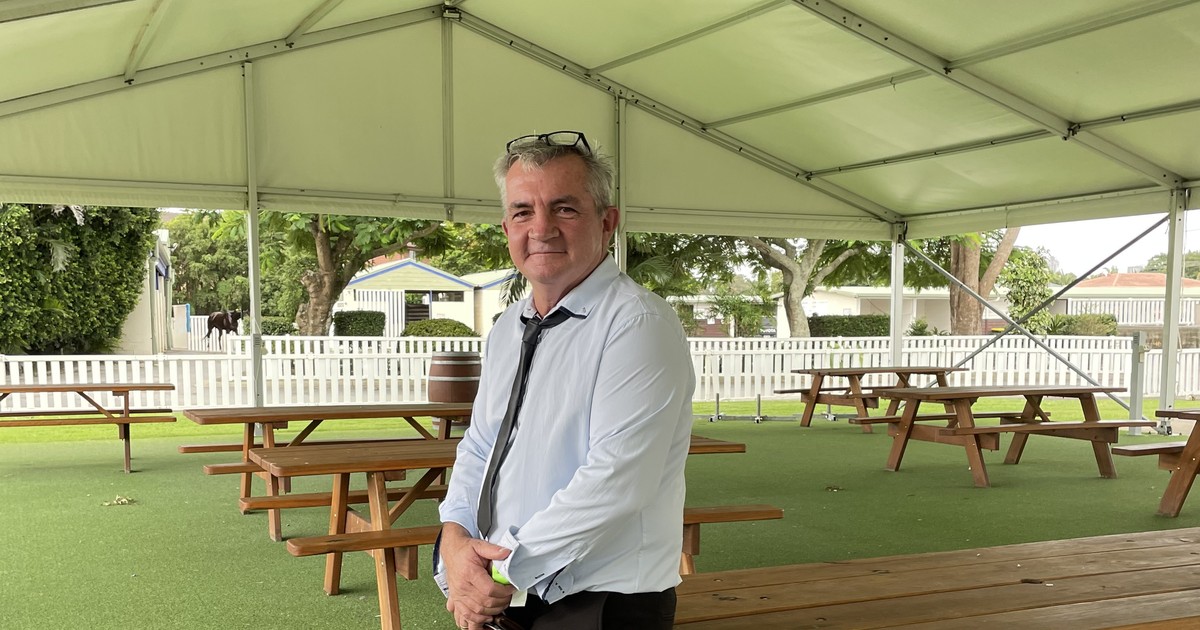
By David James, owner and manufacturer at Billabong Garden Furniture
More than 30 years of firsthand manufacturing experience, commercial case studies and practical advice about Australian hardwood picnic tables.
I did not begin Billabong Garden Furniture with a business plan, a factory or a shed full of machinery. In 1993 I was out of work, nearly broke and had just moved onto 25 acres near Halfway Creek, believing that life in the country would be sweet. It turned out to be much tougher than expected.
Some of my relatives had made picnic tables, and I had helped them when I was a kid, so I decided to make one. I had a chainsaw, a drill, a hammer and a few spanners. The timber was free because there were plenty of fallen trees on the property.
A neighbour saw the finished table and offered me $150 for it. I thought he was mad, but I accepted the money and raced out to spend the entire $150 on bolts.
How Billabong Garden Furniture Began
The $150 Table Beside the Highway
I made another table and placed it beside the highway at Halfway Creek with a $150 sign. Twelve sold in the first week. Being almost broke, I was keen, so I worked sixteen-hour days and had them all finished in about two weeks.
Those first tables were nothing like the refined furniture we make today. They were built from half-round fallen logs, sometimes with the bark still attached. Some sections were approximately 200 mm thick, and a 2300 mm table could weigh close to 400 or even 500 kg.
During the first year I made over 100 tables from timber salvaged from the forest floor. When the fallen timber on our property ran out, I obtained a salvage licence and collected logs from nearby forestry areas. Some logs weighed around 150 kg. My old trailer did not last long, so it was eventually replaced by a 1970s Valiant ute and a better second-hand trailer. The Valiant had no air conditioning, and working in the direct summer sun could be brutal.
At first, loading was done with a block and tackle hanging from the roof of a pole shed I had built. Unloading was by hand. Fortunately, gravity was usually on my side.
From Fallen Logs to Milled Hardwood
Around 1994, I began buying 200 × 50 mm boards from a sawmill. The price of a table rose from $150 to $290 to cover the cost of the milled timber.
By then, many local people already owned one of my tables, so I tried the Woolgoolga and Bellingen markets. The markets did not produce much business. For several years I drove trucks during winter and manufactured tables through the busier summer months.
The internet was also beginning to reach Australian homes. I was a computer hobbyist and had completed courses in Programming in BASIC and Data Processing Concepts, so I built a basic website myself. There was very little online competition at the time.
With dial-up internet, the photographs had to be tiny and still took a long time to appear. They began as film photographs that I scanned into the computer. Despite its limitations, the website worked. Enquiries began arriving, mostly by email, and before long I was doing very little truck driving. Email remains the way almost all our customers contact us today.
How the Billabong Name Began
The Billabong Garden Furniture name came about in 1994. I was sitting on one of the tables beside a billabong near Halfway Creek, having a beer with a mate and discussing names for the growing business. Billabong felt distinctively Australian and connected naturally with where the furniture had begun.
At the time I also made coffee tables, hall stands and other furniture, which is why Garden Furniture formed part of the name. The circular Billabong logo has remained recognisably similar ever since.
From a Roadside Table to National Commercial Orders
Three Semi-Trailers to Western Australia
One order that showed how far the business had progressed began with a phone call from the Wheatstone Project in Western Australia.
“I’m after a heap of tables, mate,” the caller said.
The heap turned out to be approximately 150 individual furniture pieces, mostly two-seat chairs with backrests. Two experienced furniture makers came up from Sydney to help. They normally worked for another manufacturer, but their employer was quiet at the time. He and I had realised that sharing knowledge and helping one another could benefit both businesses.
Small mills still had plenty of good hardwood then, although it was supplied green. With the additional hands, the order was completed in approximately ten weeks. Three semi-trailers carried it across Australia to the project. Watching them leave was a relief; I was well and truly ready for a rest.
What Three Decades Taught Us About Hardwood
What Green Timber Taught Me
For most of the business’s history, suitable kiln-dried hardwood in the sizes we needed was difficult to obtain. Green timber could shrink and bow as it dried. It could also develop splinters and the occasional split. Many customers loved the rustic appearance, but anything that became ugly or unsafe was repaired under our warranty.
We began using kiln-dried hardwood exclusively in 2024. The improvement has been substantial: no drying shrinkage, far less movement and none of the earlier repair work caused by green timber drying after manufacture.
Today’s timber arrives kiln-dried and DAR, meaning dressed all round. It carries an F17 or F27 structural grade stamp, depending on the supplied grade. It is primarily milled for structural building applications such as decks, so its strength is graded rather than assumed.
We mainly use Australian blackbutt because it combines strength, durability and availability. Years ago, we could also obtain excellent tallowwood more readily, but its supply is now very limited.
Every board is inspected. Splits, major knots and other unacceptable faults are rejected or cut out. Jigs now control the cutting and drilling, making production faster and more consistent than I could ever have imagined in the early days.
Strength Refined Through Real Manufacturing Experience
A Design Refined Rather Than Reinvented
The funny thing is that the basic picnic-table design has barely changed. During my travels I have seen similar forms in many countries. It has survived because the underlying design works.
What has changed is the material, consistency and refinement. The natural-edge seats on early tables could vary from about 100 to 300 mm wide. Today’s seat boards are consistently 200 mm wide. A current 2300 mm table weighs approximately 180 kg instead of the 400 kg or more of some early models, while retaining exceptional strength.
The furniture is completely bolted. We do not depend on nails, screws or glue to hold the main structure together. Individual components can be replaced if ever required, although complete-table replacements under normal warranty conditions have not been necessary.
To demonstrate the strength, I have driven a 2500 kg Holden Colorado up two boards until both wheels were resting on a tabletop. I have also placed approximately 3200 kg of timber on a table using a forklift. Neither table broke or suffered visible damage.
Commercial Furniture Proven in the Real World
Billabong Garden Furniture has manufactured thousands of individual furniture pieces since 1993, with the great majority supplied for commercial use.
Hospitality venues make up our largest customer group, followed by schools and sporting organisations. Procurement companies and pub groups have reordered from us for more than ten years. Northerlies Beach Bar & Grill alone has approximately 40 full-size Billabong picnic tables.
Our public location map identifies 296 places where people can see or use our furniture. The map does not include private homes or every commercial installation; it records publicly accessible locations across Australia.
Explore Our Public Picnic Table Locations
Commercial furniture must cope with far more than ordinary backyard use. People stand and jump on it. Children climb over it. It is dragged, pressure washed and left outdoors year-round. That is why I describe our approach as absolute, over-engineered strength.
Surviving the 2022 Lismore Flood
One of the strongest real-world examples came from Cubby Bakehouse after the major Lismore flood in 2022.
The business had fifteen Billabong tables, ranging from approximately two to eight years old because it had added more as it expanded. During the flood, some tables floated and others sank. Fortunately, all were trapped within the property’s fence rather than being carried downstream.
Afterward, the tables were pressure washed to remove contaminated flood mud and left in the sun for several days. They required no repairs and returned to service. Cubby Bakehouse later contacted us to tell the story and order more.
I still occasionally visit for lunch and see the tables myself. They continue to look great.
More Than 20 Years in Commercial Service
Two tables at Cable Beach General Store in Western Australia are now more than 20 years old. They are only partly under cover and were painted approximately fifteen years ago, yet they remain in excellent condition.
Tables at the Seaview Tavern and Hoey Moey have also provided approximately 20 years of pub service. With little maintenance, they now look tired, as would be expected, but they remain useful examples of how long substantial hardwood furniture can stay in service.
Warranty, Repairable Design and On-Site Assembly
A Ten-Year Warranty That Includes Commercial Use
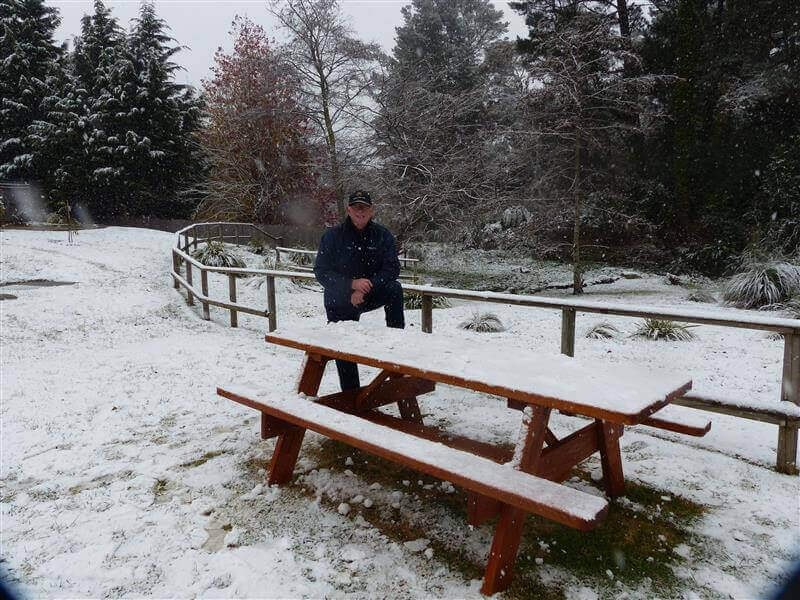
We introduced our ten-year unconditional warranty approximately eighteen years ago. It includes schools, pubs and other commercial environments. We have even replaced a board when it was nine years old.
Across those eighteen years, I estimate that we have received only about ten genuine warranty claims. Most problems were linked to constant moisture, particularly tables placed in swampy ground beneath trees where the timber never had an opportunity to dry properly.
There have also been situations no normal warranty could anticipate. Students once slid a table down a hill at a Sydney university and into a dam, where it sank. I was consulted about the best way to retrieve it. My advice was to buy another one.
Another table was struck by a car in Newcastle. The table required a replacement seat and leg. We had a very large tree land on one during heavy rain. It did no damage, but pushed the legs into the ground. After everything nature has thrown at them, we have never had to replace an entire table because failed during normal use.
Delivered in Pieces and Assembled in Place
Tables we deliver on our regular routes between Sydney and Brisbane are manufactured and checked at the factory, disassembled into transportable sections and then rebuilt in their final position.
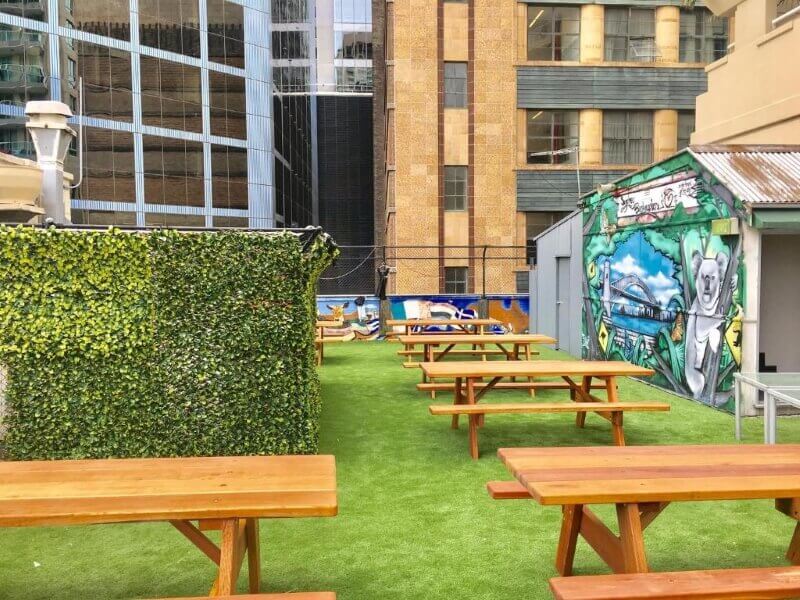
This method reduces manual-handling risks and allows the furniture to pass through lifts, narrow doors and stairwells. It has enabled installations on many Sydney rooftops, at a chain of backpacker venues and inside difficult-to-access commercial and government buildings.
The most physically difficult job involved components for six tables that had to be carried up three storeys without a lift on a hot day. I was working alone. Experiences like that are why safe planning and on-site assembly are now an important part of our delivery service.
How to Help a Hardwood Table Last 20 Years
Constant damp shade is generally harder on outdoor timber than full sun. A table may slowly sink into sand, but permanently swampy soil can keep the legs wet long enough to cause decay. When a table sits on soil or sand, placing a paver beneath each leg is a simple and effective precaution.
Our zinc-plated bolts have performed very well, including in coastal locations. Because today’s timber is kiln-dried before manufacture, it no longer shrinks around the bolts as earlier green timber could.
The biggest maintenance mistake is varnishing an outdoor table. Once water penetrates beneath a film-forming coating, it can become trapped and encourage mould. A penetrating exterior timber oil is far more suitable because it protects the hardwood without creating the same sealed film.
Owners should follow our complete maintenance instructions for cleaning and recoating advice.
Look Underneath Before Buying a Picnic Table
When someone says, “I need a table today,” and we cannot meet the deadline, I sometimes direct them to Bunnings for an imported table. I know that, in many cases, they will return for a Billabong table within a few years.
Australia produces exceptional structural hardwood. Imported furniture often cannot economically compete with the weight and timber thickness we use because heavy furniture is expensive to ship internationally.
The most important difference is often hidden underneath. Some tables appear to have boards 40 or 50 mm thick because that is the depth of the visible edge. Look underneath and the main board may be only around 19 mm thick.
Do not judge commercial furniture solely by the photographs, the decorative edge or how it looks when new. Inspect the real board thickness, the joints, the fixings and the structure beneath the tabletop. Furniture intended for a school, pub or public place should be capable of surviving the rough treatment that inevitably happens in real life.
From a $150 Table to a Way of Life
One of my favourite stories involves a brother-in-law sitting at a pub with a mate. They were discussing their families, and his mate asked what we did for a living.
“Oh, they make outdoor furniture,” my brother-in-law replied.
A few minutes later, his mate noticed the Billabong stamp on the very table where they were sitting.
After more than 30 years, this is not really a job anymore. It is a lifestyle. I am proud that a small manufacturer has been able to produce such a large quantity of furniture without compromising absolute strength and quality.
The broke bloke with the chainsaw in 1993 would never believe it could have come this far.